

Somewhere, a social media influencer is using AI to automate two months of content marketing in a matter of minutes. That influencer also made millions on Bitcoin, and doctors hate him because he knows this one weight loss secret.
Generative AI is an incredible tool, but treating it like a one-size-fits-all solution to content marketing or creating in general is short-sighted. And it will piss off your audience.
A personal disclaimer:
Before we get too deep, know that I use AI most days.
Artificial intelligence isn’t bad (unless you want it to draw hands). It has incredible uses in data processing, healthcare research, supply chain management, and even creative processes.

But it’s still unable to create something that stirs people.
Good Use vs. Bad Use
Most content marketing these days benefited in some small way from AI — even the good stuff. It’s a powerful tool for helping creatives and marketers. That’s good AI.
Bad AI uses typically stem from lazy use—relying solely on AI from idea generation through creative production.
When my students turn in fully AI-generated papers, they aren’t necessarily incorrect or poorly written. But they’re uninteresting. They feel like they were written by someone who wasn’t in the class.
That’s the real problem with entirely generated AI creative works: They’re typically uninteresting.
You expect me to read that?
I don’t care that my students use a tool they’ll be expected to use when they graduate (my journalism professors wouldn’t let us use any social media in 2008).
I care that they want me to spend my time — time I could be playing video games with my kids — reading an uninteresting paper they didn’t write.
Your consumers feel the same way.
It’s one thing to say, “Here’s a funny Spongebob rap I made with AI.”
It’s another thing to say, “Read this ‘educational’ material on retirement investing (that I didn’t write or proof) and then trust me with your life savings.”
If you think your customers are so stupid they can’t see through that, they know. And they resent you for calling them stupid.
When you use AI to generate each step of the process, you’re signaling to your audience that you don’t have time for them or, worse, that you don’t care about them.
It’s disrespectful.
Now that my rant is over let’s discuss the technical reasons why lazy AI content won’t work.
Lazy AI Won’t Help You Stand Out
Generative AI scans and categorizes pre-existing information, similar to how gray matter works in the human brain. But because it can’t parse the lived context of that information, it still doesn’t quite connect all the dots.
So, by its very nature, AI will create new things based on old things. It will use what it understands based on its programming and the data it has scanned.
A tale of two websites.
In marketing, AI does a disservice to the brand and the consumer.
Imagine two banks using similar AI models, trained on similar datasets, to create websites advertising similar products under similar regulatory restrictions.
Will those websites be very different? Will the websites accurately reflect the customer experience?
Subject-matter expertise
Speaking of banks, industries like cybersecurity, climate, finance, and medicine must translate highly technical information into language their audiences can understand.
For all its strengths, AI’s strong suit isn’t humanizing information. But, in a world full of technical jargon and AI overuse, a human touch will make your brand stand out.
When to use AI
There are great ways to use AI as a supplemental tool — heck, even a collaborator. Here are some of my favorite ways to use it in marketing and content creation:
Time blocking and planning

Tools like Motion and Trevor use AI to learn about your workflow and help you optimize your schedules and processes.
Google’s Gemini will even analyze a video of your workflow to offer feedback.
Customer profiles and sentiment analysis
Artificial intelligence can monitor what people say about your organization and analyze that content for sentiment.
Have AI scan social media and news sites for mentions of your brand and then determine whether those mentions are positive or negative. Track issues important to your brand or find out which issues your consumers care about.
Brand consistency
Because of the way AI processes information, it can be a powerful partner in maintaining brand standards. Some digital asset managers (DAM), like Brandfolder, will use your defined brand guidelines to check your other creative assets for visual and tonal consistency.
Notion’s AI tools allow organizations to build their own tool with similar functionality.
Repetitive creative tasks
Copy-proofing, design projects, and video and photo editing rely heavily on artist input, even when serving corporate marketing. However, they also require a lot of tedious work.
AI can generate audio transcripts that can be used to navigate longer videos, batch photo editing tasks based on artist input (or even past projects), conduct time-consuming video editing tasks early in the process, and reformat content.
Increase accessibility
As mentioned above, AI-generated audio transcripts can help busy teams increase the accessibility of their content nearly instantly. The same goes for image captions, alt-tags, and AI-generated audio versions of written content.
Meetings
The only thing worse than a meeting that could have been an email is rewatching that meeting recording to write the recap email.
With AI, you can transcribe a meeting recording, create a summary, and identify and assign action items.
Just a little of that human touch

Younger generations crave authenticity to a high degree because the world around them is so polished and corporate, so inaccessible. That’s why there was a massive market shift toward authenticity when millennials came of age.
The great and good Bruce Springsteen sings and talks a lot about connection, most literally in the song Human Touch.
I ain’t lookin’ for prayers or pity
I ain’t comin’ round searchin’ for a crutch
I just want someone to talk to
And a little of that human touch
Just a little of that human touch
I love this chorus because it still speaks to our social climate twenty years later.
The world is so impersonal that most of us will take an extra step if it means we experience a little bit of that human touch.
Teamwork Makes the Dream Work

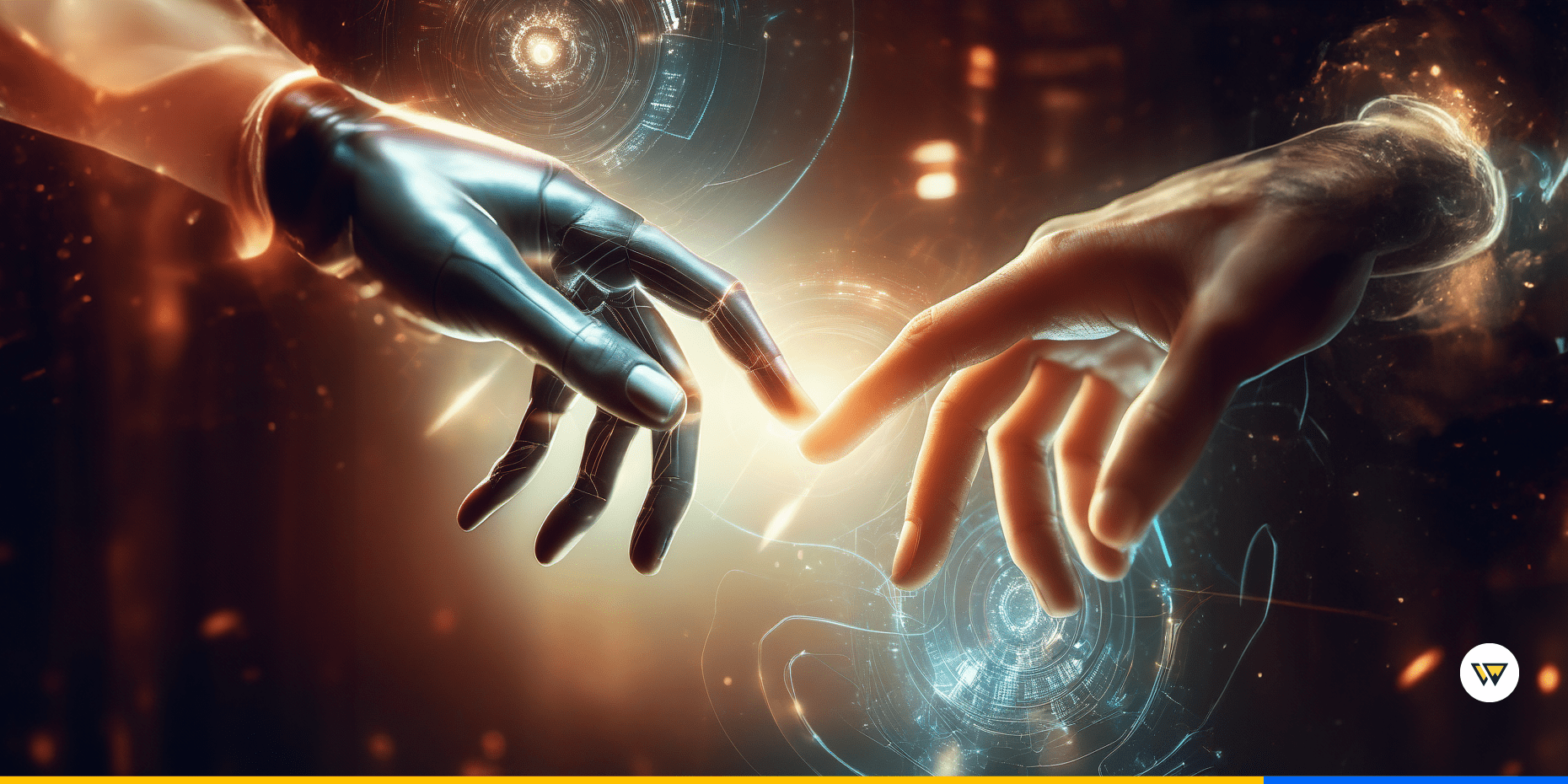
Using AI doesn’t make creative content bad, but your humanity ultimately makes it good. So, the next time you use generative AI, think about how to work with it to enhance your vision instead of using it to generate something rote.
When struggling to make your content work, collaborate with human creators who can help you infuse storytelling and empathy into your content for a more impactful message.
Supplement that human input with AI-derived insight and feedback to streamline your processes and make better work.
Balancing AI efficiency with human creativity can lead to content that stands out in a crowded market.
Are you looking for a little human touch?
The strategists and creators at Content Workshop give brands the support they need to engage in human-centered storytelling.
Contact Content Workshop to learn how we can help inject that human touch into your brand’s messaging, strategy, and content marketing.

