


Stop us if this sounds familiar. Your boss is demanding movement on AI search, but your GA4 referral report shows almost nothing from AI tools. Meanwhile, your buyer’s shortlist is being shaped inside an LLM answer engine anyway. For anyone running AI marketing, clicks can’t tell you whether that gap is costing you the shortlist.
The adoption data makes the stakes plain. Ahrefs reports that 94% of business buyers use AI search and that 42% of consumers research products with it, per NielsenIQ. A buyer who forms a view inside an answer and later types your name into a browser leaves no referral behind.
Treating clicks as the whole story is now a strategic error. A durable AI marketing strategy needs a way to measure what happens before the click.
AI Search Visibility Starts with Answers
Rankings and organic sessions remain good evidence of discoverability. But they can’t completely account for what influences a generated answer, where a buyer reads a recommendation and never sees a results page.
Measuring AI search visibility means tracking whether your priority pages, entities, product categories, and brand claims appear in responses to real buyer prompts, alongside your keyword rankings. It is the measurement side of blending SEO and GEO.
Build a prompt set from real buyer questions
Cover four question types:
- Comparison
- Recommendation
- Problem-solving
- Implementation
Write prompts the way buyers ask them, with their industry, company size, and constraints included. Broad prompts tend to return the category’s best-known names, while specific ones show how you appear in the situations you actually sell into.
Then run the same prompts on a schedule. Answers shift across engines and over time, so a single reading tells you little. HubSpot’s guide to AEO recommends watching tracked prompts over days or weeks before reading a trend. Treat the first month as calibration: you are learning how much answers move on their own before you credit any movement to your work.
Record what each answer says about you
For every prompt, log:
- Brand mentions
- Competitor mentions
- Sentiment
- Cited domains
- Answer accuracy
Visibility without correct or favorable representation is a weak win. An answer that names you and misstates what you sell does more damage than one that leaves you out.
Replace Click-Only Reporting With a Visibility Stack
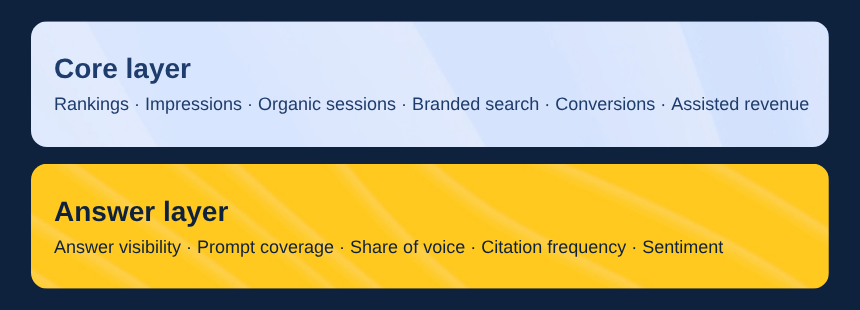
An answer can shape consideration without producing a referral session, so the dashboard needs a second layer. Ahrefs makes the case for measuring the influence conventional attribution misses, and HubSpot frames AEO as a companion to established SEO signals. Read together, they point to a visibility stack: the SEO metrics you trust on the bottom, an answer layer on top.
Keep the core dashboard
Rankings, impressions, organic sessions, branded search, conversions, and assisted revenue still anchor the report. They also hold the referral traffic that does arrive, which you can isolate with a dedicated AI Search channel in GA4. The stack picks up where that channel goes blind. Dropping these metrics in favor of answer data would open a different gap, because mentions with no conversion data can’t show whether visibility paid off.
Add the answer layer
Track answer visibility, prompt coverage, share of voice, citation frequency, and sentiment. These tell you how often the brand appears in the answers that matter, who appears beside it, and whether the engines describe it fairly.
Weight the score by buying intent
The visibility score is the percentage of tracked prompts that mention your brand, weighted by strategic importance. Strong presence on low-value questions should not outweigh weak presence on the prompts that define a purchase. Weighting is what turns AI search visibility from a vanity count into a number a CMO can defend in a pipeline review.
Then compare the score against branded-search growth, direct traffic, demo or inquiry volume, and influenced pipeline, and look for relationships that hold over time. Add one more input: ask new customers how they found you, and include AI tools as an answer option. Ahrefs recommends this survey because it captures influence no analytics tag will.
Treat Citations as Editorial Signals
AI search visibility is partly a content-quality problem and partly a reputation problem. Answer engines draw on a wide evidence network: owned content, reviews, news coverage, social material, and other trusted sources, as HubSpot’s guide describes. Your pages are one input among many.
That makes the work editorial as much as technical. A citation is a third party’s judgment that a page is worth quoting, and those judgments follow clarity, evidence, and consistency.
Audit the evidence behind category answers
Pull the domains and content types that appear in answers to your category prompts. Then identify what competitors have that you lack, whether that is a comparison page, a third-party review, or a cited study. A competitor that surfaces because analysts, reviewers, and customers describe it the same way has an evidence advantage no markup will close. Prioritize comparisons, original research, clear service explanations, expert commentary, and pages that resolve a specific buyer question.
Write for extraction without flattening the story
Answer early for the AI. Define terms precisely, support claims, and use descriptive headings, lists, structured data, and consistent brand language. But be sure to keep the story on the page, because a successful AI-generated search result can lead to a human reader on your page.
And always be sure to search for and correct factual gaps across your owned pages and external profiles. Inconsistent names and vague wording produce answers that are incorrect and reputationally damaging.
Give every strategic asset a citation role
Each asset should answer a meaningful question, hold a distinctive point of view, or supply evidence others can reference. AI can accelerate production, but speed should never cost you credibility. Subject matter experts supply the depth that makes a page worth citing, and technical buyers can tell when it is missing.
Make AI Marketing Attribution a Testable Discipline
Weak attribution calls for a repeatable testing system that admits its uncertainty. Referral traffic alone can badly understate AI influence. Ahrefs found that 21.7% of its own signups were self-attributed to ChatGPT or Claude, second only to Google. AI contributed a meaningful share of signups without dominating the referral report.
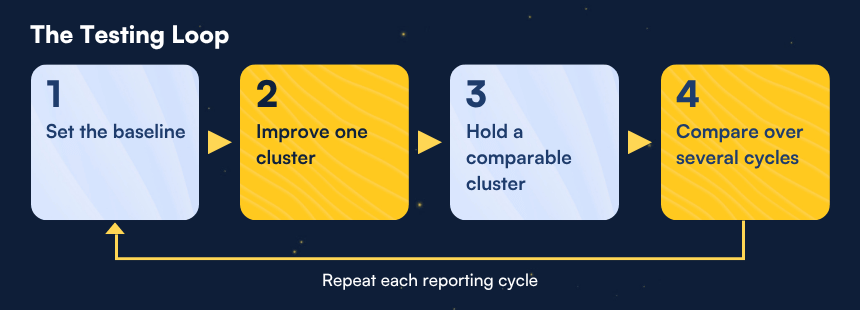
Set a monthly baseline
Record tracked prompts, brand mentions, citations, competitor share of voice, branded demand, qualified inquiries, and revenue-influenced opportunities. The baseline is what makes every later change interpretable.
Run controlled updates
Improve one defined prompt cluster, hold a comparable cluster steady, and monitor both for several reporting cycles. When the improved cluster gains answer presence, compare later movement in branded search, direct visits, assisted conversions, sales conversations, and customer-reported discovery. Treat what you find as evidence of influence, not proof of causation. Because citation authority compounds, the gains will rarely show up cleanly in a 90-day attribution report, so judge the trend across cycles. Report AI search visibility to executives with that caveat attached.
Assign owners
Give someone prompt monitoring, someone citation review, someone content updates, and someone executive reporting. The work only survives if it lives inside the content workflow. A monthly readout to marketing leadership keeps the program funded long enough to produce a trend worth reading.
Win the Answer Before the Click
This search war is decided by inclusion in the answer a buyer trusts before they visit a site or talk to sales. The question worth bringing to every quarterly review: did our brand become more present, more credible, and more likely to shape demand?
The data will stay imperfect, and a disciplined AI marketing program says so. What it can do is show, quarter after quarter, whether the answers your buyers read are moving in your favor. If you want to build that discipline into how your team measures and earns answers, Content Workshop’s AI Studio is where the framework becomes a working system.
