
ARTICLE
The Human-AI Sandwich: AI Marketing Tools and the Crucial Human Touch
 By Christina Rowell
December 22, 2025
By Christina Rowell
December 22, 2025
Introduction: Content Strategy in 2026 Requires Building a “Human-AI Sandwich”
We see a rush of marketing leaders implementing AI marketing tools to scale up their content creation efforts. Frankly, it’s risky business. Bad AI-generated content has a name: AI slop. When we talk with our clients, balancing the use of AI with staff resources has become a hot topic. Avoiding slop is just one concern. Adherence to brand guidelines and the risk of unintentionally using copyrighted works are two more.
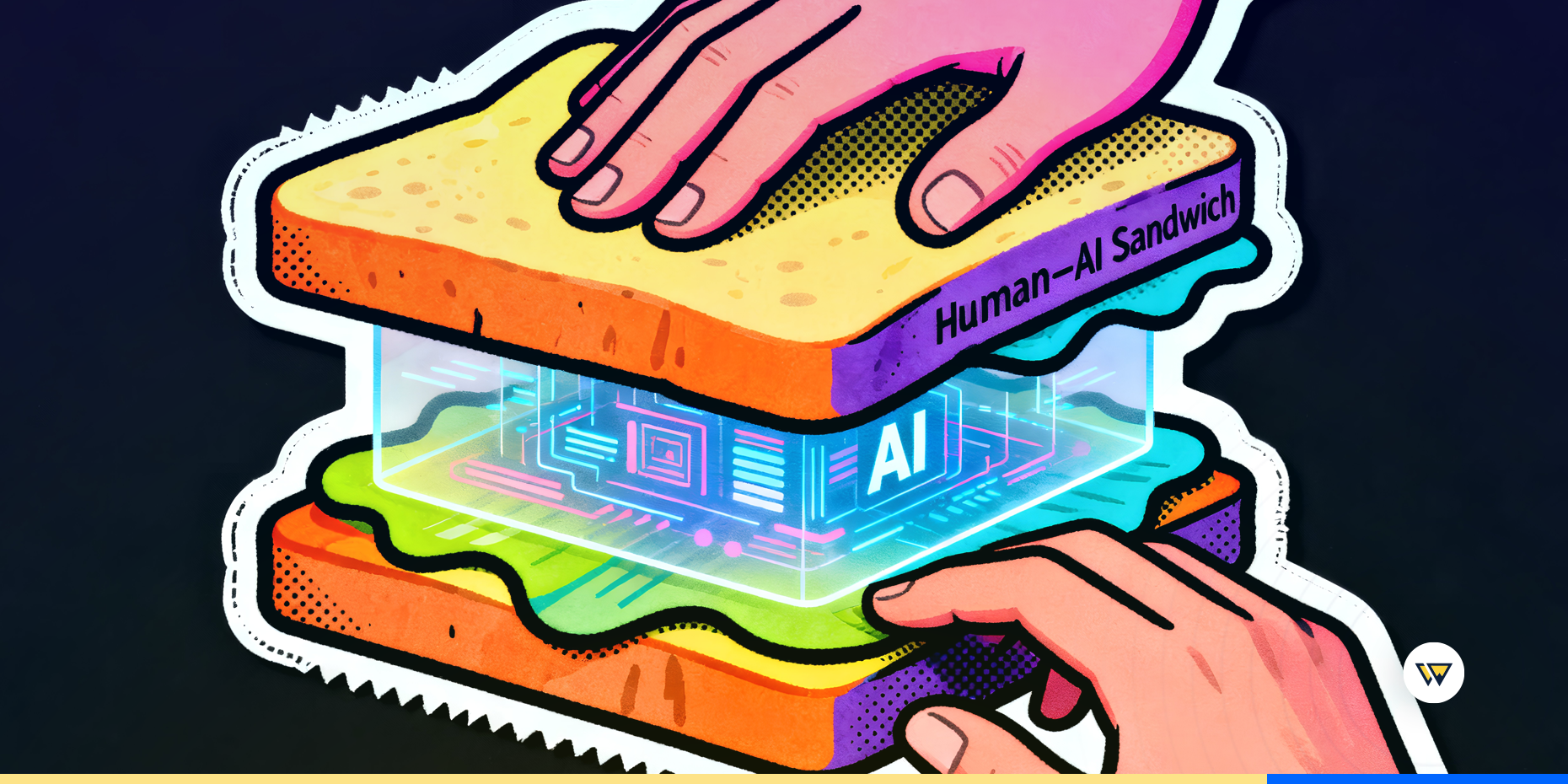
Most everyone wants to benefit from the speed and scale that AI marketing tools offer. Content Workshop is experimenting with AI too, so that we can deliver better client value at reduced costs. We’ve learned that for us humans, it is better to partner with AI than compete with it. We liken our approach to a human-AI sandwich with different layers in which you have humans building the strategy, then AI marketing tools generating a text output, finished with human oversight to perform quality control. This final check ensures that the final deliverable aligns with the original strategic goals. One measure we use to determine if the output is a failure or worthy of a Michelin star is called the E-E-A-T test. We assess whether the piece meets our standards for reflecting our Experience, Expertise, Authoritativeness, and Trustworthiness (E-E-A-T). The final result should meet your standards of excellence, not AI’s standard.
The First Slice of Bread (How about a nice sourdough?)
Getting the best results from a large language model (LLM) like Google Gemini or ChatGPT begins with research, ideation, and intent. You or your team members know your strategies and key messages best, so you have to educate your LLM. Here is an example. Let’s say you want to write a blog post about information security automation. You can begin my following the menu:
- Prep the Prompt: LLMs love specifics. Feed them your content style guides, information about your targeted personas, and key messages. You can ask an LLM to search your website for themes it detects or search for independent market statistics. Once you have that information, you can begin constructing rules to tell the LLM how to use that information for your specific post, such as word length, keyword information, etc. There are many ways to craft the perfect prompt. You can describe your objectives to an LLM and ask it to ask you questions one at a time to generate a great prompt. There are many freely available prompt frameworks. TrustInsights.ai, an advisory firm, offers several plug-and-play models that help you communicate with your LLM of choice. As you can see, all this precise information about your company and your needs is best suited coming from you, not Google, for example.
- Chef’s Kiss: Just like an IT administrator gives users permissions and restrictions to reduce risks and increase productivity, so too should you give AI marketing tools permissions and restrictions. Ambiguity can often facilitate AI hallucinations. The more precise you are upfront, the less work you will have to do on the back end.
- Bonus Tip: Another way humans can partner with AI marketing tools at this stage (call it a condiment) is to use multiple AI services. When strategizing about the sample security automation post, you could feed the information into a service like Google’s Notebook LM, a free service that lets you ask questions of your data so a team member can hone in on things like better prompts. You could use it to define an ideal prompt for a different service like ChatGPT. Experiment to find what works best for you.
Developing and executing strategies in this part of the sandwich layer is perhaps the most essential ingredient to successful AI Marketing (URL TBD) in 2026.

The Sandwich Filling: Choose Your AI Marketing Tool
If you and your team have done a good job with the first bread layer, it does not matter much whether you use Claude, Gemini, ChatGPT, or another leading AI marketing tool. They all work similarly with good inputs. Claude has the reputation as the best writer, but they all have strengths. Your best bet is to experiment to find which works best for you.
The one major consideration at this point is what you want the output to be. Typically, it’s best for a plain text output to allow you the most editing flexibility. The other major decision you must make is whether you want the AI to generate a full-blown blog post draft or an outline. Outlines can be helpful for either giving the AI additional guidance or ensuring the work isn’t too far off course. Sometimes you might want the outline and have a human write a draft of the post based on the line. You can also ask the AI to produce a full first draft of the post.
The Essential Second Slice: Making It Yours
Returning to the security automation blog post example, there is a good chance the first pass of text generation has good organization and structure but is somewhat bland. It likely needs your version of hot sauce. Ask yourself if you publish this post, could it become a great sales enablement piece or fit for a demand generation campaign? Or rather, will it make your team look like frauds and have no value to the sales? If you are an experienced marketing leader, you can probably tell.

There are a few elements of having an authentic voice versus using generic AI marketing tools. This goes back to E-E-A-T.
- Does it meet your quality guidelines?
- Does it represent your organization’s expertise and voice?
- Is it actually useful for someone in your target audience?
- Does it contain valued-added insights from your company’s knowledge base?
- Is the grammar error free?
Depending on what you find, you may ask your AI marketing to generate a full new draft or perhaps a section. It is ok to ask to fix certain sections especially if they seem too trite.
The Finishing Touches: Taking a Final Look
Everybody knows that feeling of anxiousness before hitting the “publish” button. Once you are satisfied that you have received the most from your AI, someone on your team must serve as the ultimate human gatekeeper to be in charge of quality.

In addition to grammar, this is the time to make sure that fact checking is complete and that the AI did not go off the rails with some odd hallucination (food poisoning). Is the content logical and have a good flow to it? How aligned is the text with your brand and key messages?
Accountability and the Future of AI-Enhanced Content
The Human-AI Sandwich methodology goes beyond accelerating good quality content development, it:
- Is good governance for the brand
- Helps increase the visibility of your content to your desired audiences to increase lead generation
- Creates more quality assets that sales can use with prospects
It is worth noting that while SEO techniques have been a primary standard to get noticed. AI is changing this game with answer engine optimization (AEO) and generative engine optimization (GEO) sharing the main stage with SEO. AI marketing tools have to adjust as do content and marketing pros.
The human-AI sandwich approach is a repeatable strategy to fuse the benefits of AI with you and your team’s personalized insights. If you would like to learn more about how we use it at Content Workshop, check out Explore how Content Workshop’s AI Studio provides the framework and tools to operationalize this methodology across your marketing organization.
At least for the foreseeable future, the funny thing is humans still have to do the hard part of content creation, the strategy, the storytelling, the positioning, etc. But AI marketing tools can be your sous chef, give it the right ingredients, and you can put your finishing touches on it for a great meal presentation. Hmmm…I feel a little hungry for a sandwich.
