
ARTICLE
Is Industry Jargon Cluttering Your Brand Story and Web Design?
 By JB Clark
November 23, 2023
By JB Clark
November 23, 2023
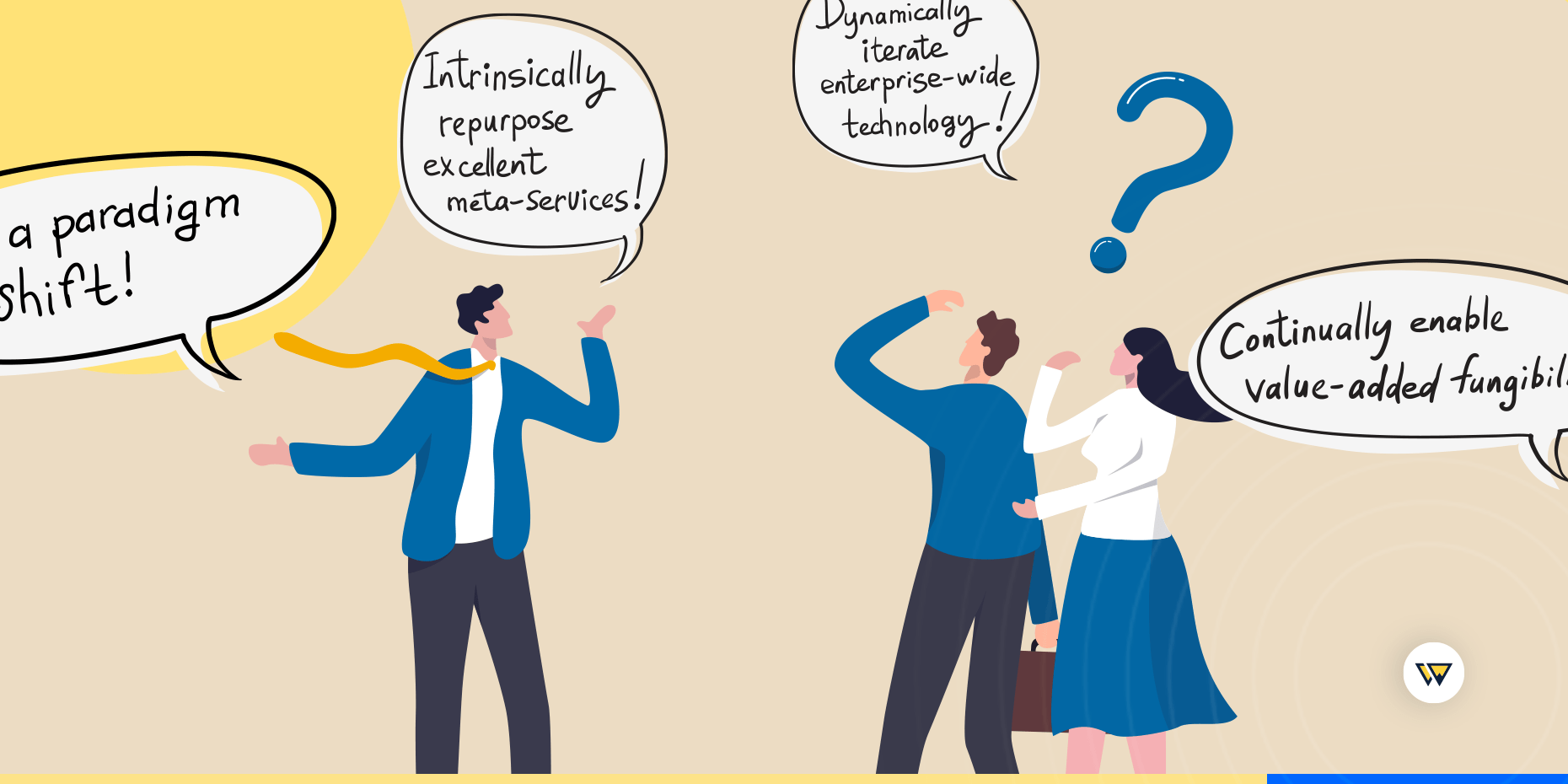
Your web design is the first thing potential customers see when researching your brand. Don’t let their first impression be riddled with jargon and indecipherable industry terms.
We all use jargon, and that’s ok. Heck, I was talking about CPMs, KPIs, and CTRs this morning. But industry-specific jargon becomes so familiar that we forget we’re the only ones who understand it.
Some days, we even use industry jargon to sound more intelligent. It seems authoritative, convincing, and confident. It’s not.
Using too much jargon can confuse and even alienate potential customers.
Your brand story and web design aren’t the place for jargon. Save that for the trade shows. The words used to describe your products, services, and solutions should be jargon-free.
Don’t give them a headache. Tell them a story.
Take My Wife (Or A Tale of Two Stories if that’s not a good cliché joke).

My wife is a nurse — a great nurse. She delivers babies. I write about content. There is no question which of us is more important to the human race.
However, nurses have a crucial flaw: they can only communicate in jargon.
Every day, my wife comes home from work and says something like:
“We had a baby that was breech. We attempted an ESV but still had a section. Went and saw them in mother-baby, and they were good.”
That roughly translates to:
“Here is a story of how I brought life into the world today! We had a mother come to us with an emergency pregnancy, and we were able to perform life-saving surgery and deliver a healthy infant. I stopped by her room on my way out, and they were already recovering and looking healthy.”
Which story is better?
Understanding Jargon

Please don’t think I’m saying all jargon is bad. In-group lingo is shorthand for more complex ideas and makes communication more efficient amongst others who are “in the know.”
In cybersecurity, talking about a firewall is easier than an ingoing/outgoing network security monitor. But to the people hiring a cybersecurity firm (i.e., people who need help because they don’t understand cybersecurity), “firewall” is a word from an early 2000s hacker movie.
Companies use jargon to sound knowledgeable and professional—to impress potential clients and industry peers. But to industry outsiders (your customers), jargon comes across as confusing, vague, and sometimes condescending. Even worse, it opens the door for misinterpretation.
Jargon should not be central to your brand story.
Jargon Alienates Prospective Clients
Imagine asking a Starbucks barista about a complicated drink, only for them to repeat the complicated words in a different order. You wanted to know what it tastes like, if you’re allergic to any ingredients, and whether it’s hot or cold.
No one wants to ask an expert for help if they leave feeling dumber.
The language on your website is an opportunity to break down the barrier between your visitors and the solutions you provide.
Jargon Dilutes Your Message

Adding unnecessary words to a message dilutes its meaning. Adding words a reader doesn’t understand to a message (jargon) dilutes it even further.
Jargon lessens the impact of your messages. And in today’s business climate, jargon is often seen as a cliché or even a cover for incompetence. Many consumers perceive jargon as a cover for shortcomings.
Creating Confusion
In marketing, anything that distorts or prevents a message from being understood is called noise. There couldn’t be a more apt description for jargon.
When your website visitors are flooded with industry terms, they hear the Charlie Brown teacher voice, “Mwah, mwah, mwah, mwah, mwah, mwah, mwah.”
The noise prevents the message from being clearly heard and wholly understood.
The Impact of Jargon on User Experience and Customer Decision-Making Process

While jargon is helpful to insiders, it doesn’t serve your customers. Jagone speaks to services and features instead of the end-user benefit.
Industry-speak causes confusion and disengagement, overshadowing the company’s unique value proposition. But that sentence was jargon, too. Let me try again:
Speaking in industry lingo leads to the loss of potential customers.
It deflects attention from the benefits and solutions your company provides. It doesn’t tell them how you can improve their quality of life.
Peer-reviewed research tells us that jargon gets in the way of comprehension of scientific and technological information. But most of us haven’t read those studies because they’re written in, you guessed it, jargon:
“We find that the presence of jargon impairs people’s ability to process scientific information and that this impairment leads to greater motivated resistance to persuasion, increased risk perceptions, and lower support for technology adoption. These findings suggest that the use of jargon undermines efforts to inform and persuade the public through the cognitive mechanism of metacognition,” according to a 2019 study by Olivia Bullock and her colleagues at Ohio State.
More simply put, people are resistant to and untrusting of jargon-heavy messaging. They also have trouble understanding and remembering those messages.
The same is true in the realm of healthcare:
“Jargon use in pediatric surgical consultations is common and could serve as a barrier to informed or shared parent decision-making,” according to a 2019 study in the journal of Patient Education and Counseling.
Your competitor’s jargon is your opportunity.
Jargon is so prevalent that the U.S. government has multiple guides to help federal employees avoid jargon and communicate clearly.
Since jargon is prevalent in so many brands’ marketing materials, you have the opportunity to speak plainly.
Clear language in your brand story and web design will cut through the noise and differentiate your brand from the competition.
Humanize Your Brand Story and Web Design
The next time you’re tempted to use jargon on your website, remember your most recent health insurance “explanation of benefits.” Copay, coinsurance, deductible, PPO, HMO, buy-up — that’s what all jargon sounds like to the uninitiated.
Humans learn and relate through storytelling. It’s how we’ve collected knowledge since the beginning of time, long before the printing press or written word.
So, tell your visitors a story where they can be the protagonist.
Tell them who you are and how you can help. Answer their questions and show them the next steps you want them to take.
It doesn’t have to be informal or overly simple. It doesn’t even have to be long. Engaging and understandable websites help people understand exactly what you do in as little text as possible.
Use everyday language to create a connection with your website visitors.
But, Sometimes Jargon Is the Only Way
Often, in B2B settings, jargon is acceptable or even necessary. For instance, a cybersecurity firm may want to target overwhelmed IT directors at mid-sized companies. Those IT directors likely understand the terminology and don’t want to spend extra time reading unnecessary explanations.
Or in the case of healthcare-to-healthcare communications. My wife’s nursing lingo is incredibly helpful to the other nurses flying past each other in hospital hallways. Jargon helps HR departments, medical office staff, and health insurance providers easily categorize information.
The occasional use of jargon can also be a tool for turning “outsiders” into “insiders.”
Think back to Starbucks. The Starbucks menu is its own language, but the baristas are trained to explain the terms to customers in a way that invites them into the exclusive club. You feel slightly cooler now that you know what a Venti Turtle Ristretto is.
Find the Balance
Minimizing industry-specific jargon can significantly enhance a prospective client’s understanding and interaction with a company website. But the occasional use of jargon has its place, as long as it doesn’t exclude your audience.
Balance is key.
- Do you break down your brand’s benefits in plain language?
- Do you use industry terminology only when needed?
It’s a good idea to regularly evaluate your company’s website and marketing materials for jargon and industry-speak. Taking the steps to simplify the language while reinforcing your expertise will increase visitor trust and engagement, which keeps visitors on your website longer.
Do you need help humanizing your brand story and web design?
Content Workshop can help. We help brands speak their audience’s language by crafting clear and compelling website copy.
