
ARTICLE
Mastering AI Marketing: Strategies for the Modern Tech Enterprise
 By Christina Rowell
December 16, 2025
By Christina Rowell
December 16, 2025
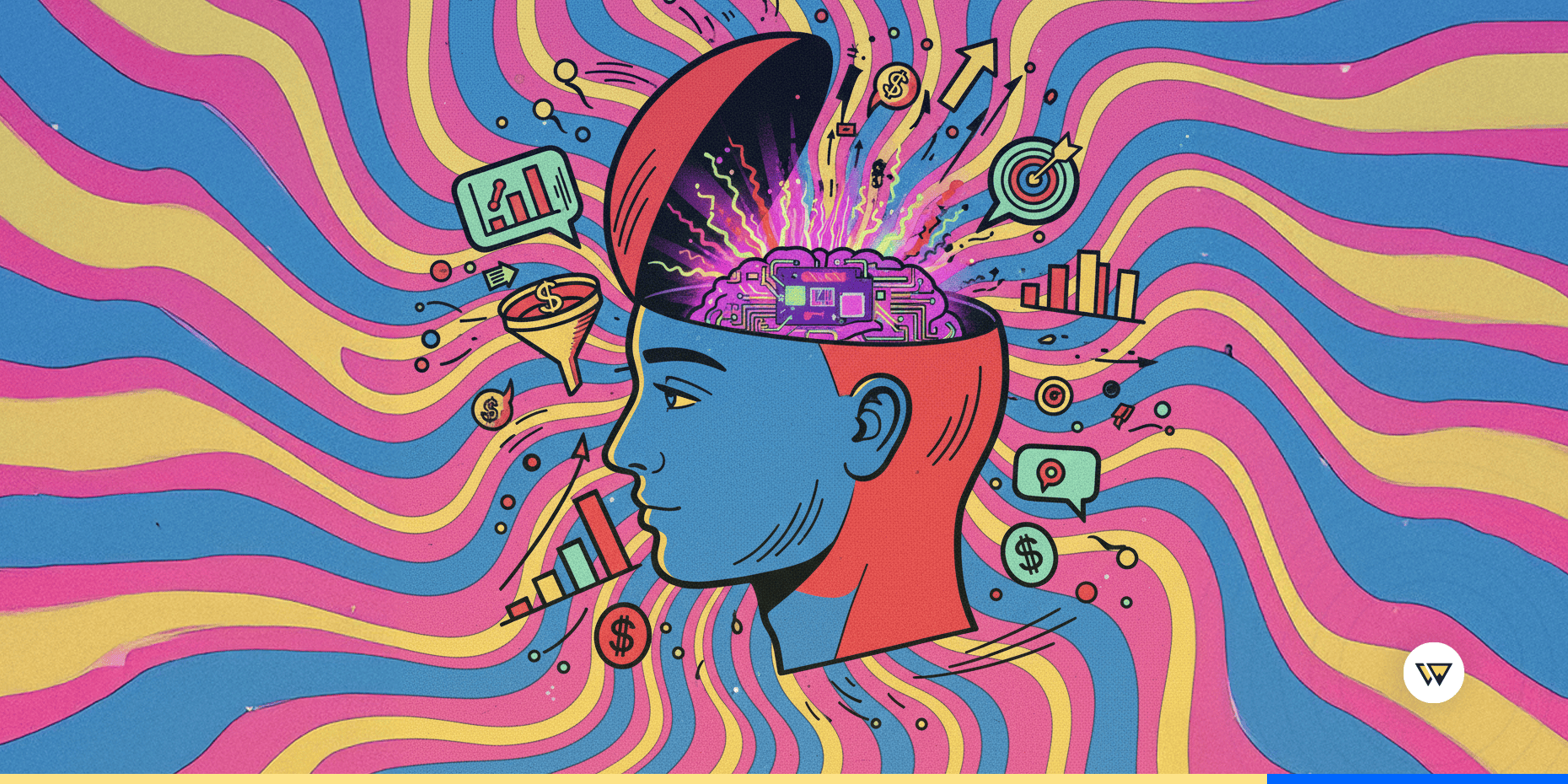
For years, popular movies have envisioned future worlds shaped by artificial intelligence. In films, AI does everything from the thrilling, like powering spaceships so explorers could “boldly go where no one has gone before,” to the terrifying: initiating nuclear showdown and even apocalypse. AI is no longer a futuristic concept existing only in imaginary realms; it is here in the real world, touching our daily lives. While we aren’t yet beaming ourselves aboard spaceships (and so far we’ve avoided apocalypse), the exciting reality is that AI has many positive and powerful applications for life and business. It has already become a foundational pillar of modern marketing for tech enterprises.
When businesses leverage AI marketing, they strategically deploy artificial intelligence as a tool for efficiency and scale. AI marketing is more than just chatbots; it also includes predictive analytics, hyper-personalization, and automation. When used in tandem with human creativity and expertise, AI can drive measurable ROI, unparalleled efficiency, and data-driven precision, empowering companies to meet the high-stakes nature of tech marketing. Mastering AI marketing at the enterprise level requires a strategic, company-wide adoption plan focused on high-value applications, not just tactical tools.
Part 1: Foundational Applications of AI in the Marketing Lifecycle

Let’s take this idea from theory to practice. How can AI boost your marketing strategy? What are its specific applications, and how can they empower your business to reach its goals?
- Data Analysis and Insight Generation
If you’ve ever spent hours poring over huge spreadsheets, mining for actionable insights till your head pounded and your eyes crossed, then you understand what a time sink data analysis can be. If you’ve ever lamented the lost hours and thought, “There must be a better way,” there finally is. Enter AI.
AI excels at sifting through massive, unstructured datasets faster than human analysts. Examples of these datasets include product usage logs, forum sentiment, and campaign performance. AI can save countless human work hours by efficiently performing tasks like these:
- Sorting data into manageable subsets
- Analyzing numbers with specific parameters to answer targeted questions and provide essential insights
- Filtering out irrelevant data to help businesses focus campaign efforts in the most productive direction
- Searching for specific links and threads
All these tasks inform your marketing decisions, so you can direct resources in the most effective ways. AI also excels at identifying correlations that might not be immediately obvious. For example, AI might identify a subtle link between specific feature adoption rates and churn risk for a SaaS product. Bottom line: Using AI to analyze data saves your team time and energy. AI does the “grunt work” of sorting and comparing numbers, freeing your team to apply their creativity and expertise to tasks that require human insight, interpretation, and application.
- Predictive Analytics and Lead Scoring
Some AI models go beyond simple demographic firmographics to predict lead quality and conversion probability. These insights are invaluable in guiding your marketing strategy to convert the most leads.
Machine-learning algorithms such as logistic regression or random forests can dynamically adjust lead scores in real time based on in-session behavior. For example, algorithms use logistic regression to predict whether a lead is likely to churn or convert, and they employ random forests to make predictions that focus marketing efforts in the most effective direction. All this information boosts productivity and converts leads into sales.
- Content Personalization and Dynamic Delivery
Wouldn’t it be great if you could personally engage with each visitor to your website, evaluating their specific needs and tailoring their site experience accordingly? With AI, you can. AI personalizes marketing content and offers dynamic delivery. It serves highly relevant content versions to different segments or even individuals at the exact moment of engagement. As potential clients peruse your site, AI offers each person the specific headlines, case studies, and calls to action that best suit their needs and stage in the buying cycle.
Part 2: Strategic Advantages for Tech-Heavy Industries

If the idea of connecting with clients and customers through artificial intelligence sounds—well, artificial—think again. AI marketing offers specific strategic advantages for tech-heavy industries to improve the customer experience and guide productivity.
AI-Powered Customer Experience (CX): Building Trust and Affection
With so much of our business taking place online rather than in person, AI marketing tools help businesses connect more meaningfully with their customers and clients, even without face-to-face interactions. AI takes what would otherwise be an impersonal online experience and customizes it so each customer feels seen and valued.
- Meeting People Where They Are: Customers have questions, and AI has answers. AI-powered tools like smart knowledge bases and natural language processing (NLP) chatbots handle complex technical queries, providing instant, accurate answers. By offering users timely answers in easy-to-understand, friendly language, you reduce friction in the customer journey.
- Delivering Hyper-Contextual Content: AI identifies a user’s exact stage in the buying cycle (awareness, consideration, decision) and instantaneously delivers the most helpful, customized content. For example:
- If a user is in the decision stage, AI can shift from offering a beginner guide to a detailed competitive feature comparison, facilitating a final decision.
- If a cybersecurity firm prompts AI to adapt content based on a user’s recent site searches, AI might meet a visitor’s specific need by instantly swapping a case study about firewall security for a study on endpoint protection.
- Anticipating Needs: AI allows you to stay ahead of the game in key areas of customer support. For example, an AI system can analyze support tickets to proactively flag product documentation gaps before they become major customer issues. Proactive service makes customers feel valued, and early awareness of potential concerns prevents frustration.
Using AI to offer your customers this level of proactive, customized service builds brand affection and trust, and that trust pays generous dividends. It converts simple transactions into long-term partnerships, providing a critical advantage in high-trust industries like SaaS and manufacturing.
Competitive Intelligence and Market Sensing
Today’s business moves at a blistering pace, and it’s tough keeping up with all the hot-off-the-presses changes day to day—much less hour by hour. Who has time to sit around scrolling news headlines, industry insider blogs, and social media trends while also running a business? Savvy businesses use AI to monitor vast swathes of the Internet for the specific information their organization needs to stay relevant and adaptive. AI can scan news reports, social media outlets, and even the dark web, searching for information and updates pertinent to your industry. You provide the search terms and parameters, and AI takes the search from there, providing you with reports and time-sensitive updates tailored to your concerns.
AI can help you track competitor product launches, pricing changes, and shifts in regulatory language, keeping you informed and ready to respond. Having access to this of-the-moment information is especially critical for cybersecurity firms and manufacturing industries. Because AI goes hand-in-hand with automation, businesses in these industries can leverage AI’s capabilities to give them an edge in their fast-paced markets.
Part 3: Implementation and Ethical Considerations for AI Marketing
Maybe you’re thinking, “Sounds great—I’m convinced AI marketing is the way to go, but I’m overwhelmed by all the possibilities.” Where do I start? As Julie Andrews sang in The Sound of Music (without the aid of AI or auto-tune), “Let’s start at the very beginning, a very good place to start.”
Build the Right Infrastructure
Before you can deploy AI effectively, you’ll need to have the right infrastructure in place. When you build a custom GPT or Gem, its output will only be as reliable as your data, so you need a system that produces clean, organized data. When you tag a well-built database into AI prompts, you ensure that your processes and people are working from accurate, up-to-date information.
AI tools must work with your existing systems. Otherwise, your team may be confused by conflicting information. Integrate AI marketing tools with your sales and product systems from the start to maintain a unified customer view.
How to Start Using AI
When you’re ready to start using AI to support your marketing, don’t pressure yourself to make sweeping changes right away. Begin small. If you don’t already have clear standard operating procedures (SOPs) for every process you are considering using AI in, build them. Now you’re ready to explore the possibilities one step at a time:
- Begin by identifying manual processes that already work, and look for steps in the process where you can deploy both automation and AI thinking. (Ask: What part of this process feels tedious? Or more to the point: What part of this job sucks?)
- Remember, automation and AI are not the same thing. Most of your tools already have built-in automation steps you can trigger with an application programming interface, or API.
- Only use AI when you need calculations, organization, analysis, and other outputs that would normally require a human mind, but can be effectively performed by artificial intelligence.
- Build humans into the process at key points—we call these essential junctures “Human-in-the-Loop steps,” or HITL. Once your process is running, you can always pull back on how often a human needs to be tagged in.
- Don’t get ahead of yourself, going all-in on one AI tool. Instead, use an external builder that allows you to connect many tools. That way, you can substitute a new, better tool as AI progresses.
Talent and Training
If you or your team members worry that AI solutions could undermine human jobs, remember this: AI doesn’t replace human marketers; it augments their productivity. AI functions as a co-creator and collaborator, removing the tedium from repetitive tasks but never serving as a replacement for strategic human thought.
Think about your team’s least favorite tasks. When you ask for volunteers, everyone shouts, “Not it!” Chances are, those tasks are repetitive, time-consuming, mind-numbing, and creatively unfulfilling. Such tasks are often excellent places to sub in automation or an AI tool. This liberates your team members from hours of mindless tedium so they can devote their time and energy to more creative tasks.
What might this look like in the real world? Many marketers are intimidated, even overwhelmed, by the blinking cursor on a blank page. Once they have an idea or outline, they are good to go, but first, they need a creative kick-start. AI can help your team avoid writer’s block and decision fatigue by providing a bank of ideas with new angles and fresh topics. It can take the process several steps further, turning meeting notes into a proposed outline or using your brand guidelines to produce marketing materials like blog posts. This helps your team produce more website content faster and more efficiently.
Once you incorporate AI into a workflow, you still need human touchpoints throughout the process. It’s never wise to post AI-generated content without touching it. Build in mandatory human oversight and quality assurance (QA) for all AI outputs, from campaign parameters to generated content, ensuring accuracy and brand voice alignment. Encourage your team to think of AI-supported workflows as a “human sandwich,” with human touch on the front and back end of production.
Today’s marketers need to become “AI operators” who understand model inputs and outputs, and the ethical implications of using artificial intelligence in their industry. Your greatest asset is a talented, motivated team member who can leverage AI to multiply their skills and productivity.
Ethical AI and Trust
As you incorporate AI into your systems, make sure you adhere to best practices for AI use in your industry. All processes must comply with data privacy requirements (e.g., CCPA, GDPR). Be transparent about how you use AI in making marketing decisions, and implement safeguards to avoid algorithmic bias. In technical fields, an AI’s misjudgment based on biased data can cause severe brand trust damage.
Here’s where human team members remain invaluable. They can help AI produce reliable data by:
- Giving AI context for all data
- Requiring AI to double-check findings against industry standards
- Asking AI to cite every fact and figure
Human intuition and insight are essential for responsible and ethical AI use. AI is not a replacement for your team—it’s simply a tool that lightens their workload while amplifying their output.
Part Four: Iterative Advancements and Quality Assurance
Ongoing quality assurance of AI outputs is vital. Not only should you deploy HITL stopgaps, you also need a process to flag common issues so you can train the system to avoid them. An AI marketing expert should perform regular system maintenance, including checkups of how well the AI retains new knowledge and processes.
Maintaining high-quality materials means continuing to produce human-led assets. AI cannot completely replace human production—over time, all-AI content may begin to sound the same, with many recycled ideas. At Content Workshop, we advise brands to continue producing high-quality, human-created content for their top-performing products and services. A good rule of thumb is to have humans create twenty percent of your content.
Human-designed assets can serve a secondary purpose by further training your AI systems. Here’s what that looks like: Have AI create a piece based on an outline or brief, and ask your best writer to do the same. Edit and perfect the human piece. Then feed the human piece back into your AI tool and have it look for differences. Add any positive differences to the AI system’s knowledge base.
The Future CMO Is an AI Strategist
Successful AI adoption is not a one-time switch; it’s a journey. That journey requires continuous testing, learning, and refinement. You don’t have to change everything at once—start small with high-impact use cases such as content development, and scale systematically, always linking your AI initiatives back to your core business objectives.
You don’t have to be an AI expert to lead your company forward. The CMO of the future is an AI strategist who brings the right people and tools together to equip their team for success. You can bring in AI marketing experts to create your AI ecosystem, train your staff, and perform system maintenance and support.

This is where we can help. At Content Workshop, we help clients use AI to save time and increase productivity. We empower teams to employ automation and AI to enhance their creativity and maximize their expertise. We begin with an assessment: Where would your team like to save time and energy? How might automation and AI alleviate your pain points and moments of tedium? From there, we identify which processes need automation (like apps and software) and which steps would benefit from AI. Then we help you map a human workflow and build any needed systems, like customGPTs, Gemini Gems, and Claude Artifacts, to name a few.
Next comes enablement: training and implementation. Our initial assessment evaluates your team’s comfort level with using AI. Most teams range from reasonably competent to completely unfamiliar, and we meet each person where they are. Tiered training helps your entire team become confident using the workflow and tools. We can even train team members one-on-one.
AI is here to stay, and tech businesses that want to remain relevant and competitive are embracing it to drive efficiency and scale. The future is here, and today’s marketers are boldly going forward into new territories where no marketer has gone before. Are you ready to explore?
