
ARTICLE
Domain Authority vs. Page Authority: What’s the Difference (And Why Should You Care?)
 By David J Ebner
July 1, 2025
By David J Ebner
July 1, 2025
Whether you’re writing an informational web page or sharing your knowledge, approach, or hot takes in an engaging blog post, you want to make sure people see it. Sure, you can directly link to your new page on social media or in an email, but as part of an effective content strategy, you’ll need to attract more attention through organic traffic.
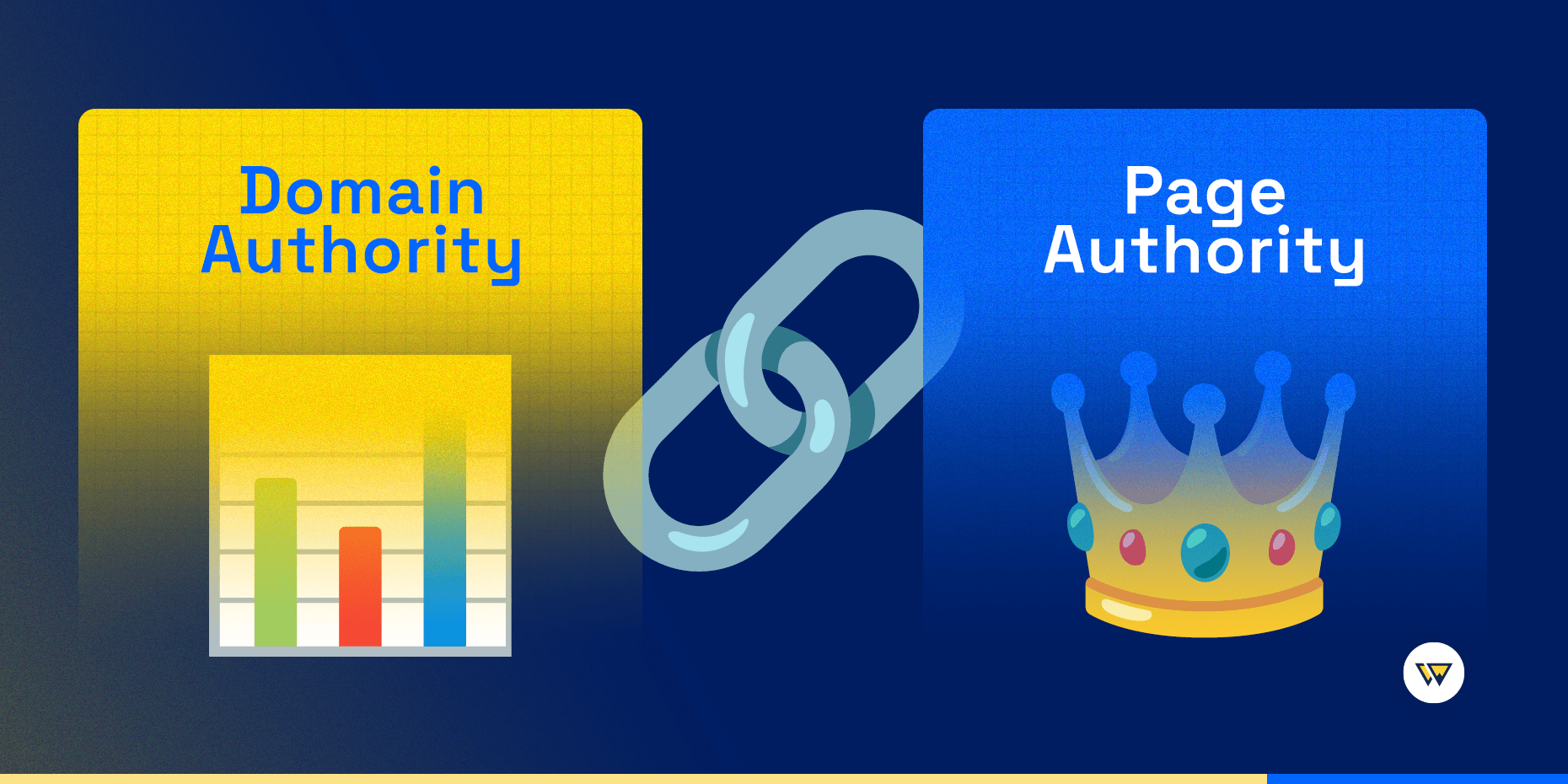
Enter: Domain Authority and Page Authority. At first glance, they sound similar—and they even come from the same SEO tool, Moz—but they serve very different functions when it comes to determining your site’s performance. Rather than functioning independently, they go hand in hand to help you take the right steps to increase visibility on your pages.
What is Domain Authority?
Moz introduced Domain Authority (DA) in 2004 as a method to predict the likelihood of a domain’s ranking in search engines. This metric rates a whole domain (e.g., yoursite.com) on a scale of 1 to 100, using factors such as backlink quality and quantity, individual page authority, topical authority, and spam content to measure a website against others in the same industry. The higher the number, the more likely the site is to appear higher in a search compared to competitors.
What is Page Authority?

Page Authority (PA), also created by Moz, predicts how well a specific page will rank in search results. Like DA, it’s rated on a score of 1 to 100 and uses many of the same factors within the algorithm that rank it. Unlike DA, it focuses on a single page (e.g., yoursite.com/this-awesome-page), with other pages and the entire domain contributing to its overall score.
So why did Moz need to complete a whole separate metric? When you search something on Google, specific pages that provide answers to what you’re looking for—and not websites’ homepages–are what you’ll get as a result. This prompted Moz to develop PA as a way to compare the ranking potential of individual pages.
How do DA and PA affect each other?
Lucky for you (and us), the efforts you put into increasing your DA or PA will almost always positively affect the other. Work smarter, not harder, right?
As you identify keywords and compare data from other high-ranking sites in the industry, you use that information to create the quality and volume of content that will increase your DA. As your DA score increases, it’ll positively affect your PA scores as well.
It works the other way around too. The primary driver of PA is backlinks from unique referring domains, which means it can be increased by acquiring more of those (but multiple links from the same domain to the same page do not provide additional benefit). As your individual PA scores increase, your DA will increase too.
Oh, they affect Base Page Authority too!
Another fun perk to keep in mind is that these efforts can lead to an increase in your Base Page Authority (BPA). BPA is the initial, lowest PA score assigned to a new page. So, if your DA is high, then any time you publish a new web page or blog post from your domain, it’ll automatically have a decent score from the start.
Using DA and PA together in your content strategy
As you build your domain, focus on both of these metrics. A big part of what you’ll be looking at and basing your strategy on isn’t necessarily your own score, but the scores of competitors’ sites and pages as well.
Using DA and PA together, you can:
- Prioritize content for link building.
- Optimize individual blog posts, product pages, or landing pages.
- Spot underperforming, but important, content.
Is it strategic? Or tactical?
Analyzing DA and PA metrics enables you to determine the next steps to take. DA serves as a strategic indicator—it helps you identify high-authority domains to get backlinks from, as well as understand the difficulty of ranking for new terms when competing with other sites.
PA, on the other hand, is more tactical, highlighting the gap between a page’s current standing and the authority required to rank in the top results for target keywords, which helps you track the performance of your key pages (e.g., product pages or high-converting blogs).
Avoid these metric mistakes
As you work more with DA and PA, it’s easy to get sucked into over-analyzing or even focusing on the wrong thing. Here’s some common “mistakes” we tend to notice:
Thinking PA is only influenced by backlinks. Internal links matter too! This is why building your own high-authority pillar or resource pages is a notable task—it provides a page you can link back to frequently.
Trying to raise DA by simply adding content. Yes, you need to add content to beef up that score. But if no one acknowledges its importance, it’s useless. You need links that direct to your pages, showing search engines and competitors that your content is valuable.
Treating DA and PA as direct Google-ranking factors. These metrics are third-party indicators, not direct signals. They can boost SEO and predict a higher ranking, but it’s not guaranteed.
The secret sauce to Content Workshop’s backlink strategy

When it comes to building up our clients’ DA and PA scores, we’ve got a few ideas on what works and what doesn’t. Let’s dig into how we approach these metrics at Content Workshop.
Using PA to optimize pages
Obtaining backlinks is our primary strategy for ranking on a specific keyword; therefore, we optimize pages to increase their Page Authority (PA) to match that of top-ranking pages. Initially, each backlink typically equates to one additional point. But after a page has received about four backlinks, it requires more links for subsequent increases.
Writing quality, educational content can naturally attract links as well. That’s why we recommend focusing on creating content that informs readers and enables them to understand concepts well enough to apply them on their own. This boosts your credibility and positions you as an authority on a topic, so others will direct to your page as a valuable resource.
Keeping it on a schedule
When it comes to acquiring backlinks, time matters. Concentrated efforts typically lead to better results than a slow, gradual approach. Backlinks and their website are considered appreciating assets over time. The more you can get out there on a timely basis, the more time you’ll have to positively impact your scores, so we work on moving in “sprints” to maximize our impact within a shorter timeframe.
Acquiring strategic backlinks
Not all backlinks are created equal, so we use DA to identify high-authority sites from which we want to obtain backlinks. The higher the quality, the greater its impact on our own score. And since cold outreach to dream domains has a ridiculously low success rate, we do this in a couple of ways that do work.
First, we focus on creating (for ourselves and for our clients) high-quality, valuable content, including pillar pages, informational blog posts, resource pages, and other linkable assets, and link to those in our own writing.
Second, we work through a backlink marketplace to buy them. No, this isn’t some scammy black market where chaos rules and we take what we can get. It’s an ethical–and effective–way to find aligned companies to partner with that you might not have otherwise known were looking for backlinks, too. Thought leadership activities like podcast appearances, partnerships, and joint content creation serve as other ways to gain backlinks.
Prioritizing and controlling your own content
When working with other domains to exchange links, we prioritize writing the content ourselves. That gives us complete control and ensures high-quality writing and the type of potential referral traffic that aligns with our goals. This also helps boost our own authority, as we provide value to the host site with a relevant backlink. We look for sites with relevant audiences, high domain authority, low spam scores, and good traffic when purchasing guest post opportunities with backlinks.
But wait… Is buying backlinks legit?
Yes. Finding partnerships through reputable marketplaces is a legitimate practice, and there are often big-name, high-authority businesses on these platforms looking for the perfect page to link to—and be linked from. Incidentally, not all exchanges are monetary. There are often guest writing opportunities where free content is compensated with a link or two.
Backlinks for your business
There’s a lot to keep in mind when it comes to building up your domain, and using DA and PA to keep track of your progress is only part of the puzzle.
Partnering with Content Workshop means you won’t miss any of the pieces–we’ve got the strategy down pat. Contact us for expert guidance on a customized backlink strategy tailored to your business.
